Here’s What Utility Leaders Need To Know.
Population growth, ageing infrastructure, tightening regulation, and a new wave of regional investment are converging at once. For water utility leaders across East Africa in countries like Kenya, Tanzania, and Uganda, this is a defining moment that determines what the future looks like.
Read on for:
Why are your most significant losses in water are going undetected.
Investment, regulation, and technology are creating a window for action.
Outcomes from White House Utility District, Puerto Rico Water, and City of Boise.
A practical framework for identifying the highest-value first step.
If you’re a water/wastewater utility leader in East Africa, you are navigating unprecedented simultaneous pressures. Populations are rapidly growing. The infrastructure was designed to serve only a fraction of the demand today. Climate variability is making planning and assumptions that were previously made unreliable. Budgets constrain against a scale of need that continues to grow. And regulators across countries like Kenya, Tanzania, and Uganda are raising the bar on performance standards.
The pressures are manageable individually. The challenge is that they’re arising collectively. It’s a sign of an inflexion point that can separate utilities that will thrive over the next decade from those that will fall behind.
The Visibility Gap: The Problem Most Utilities Aren’t Measuring
People tend to focus on the gaps that are easily observed: more pipes, more treatment capacity, more capital. These are real needs. But there is a critical, less-visible gap you may not be addressing that is worth your attention.
Across the region, water and wastewater utilities are operating with limited real-time visibility into what is happening inside their networks. The consequences are measurable.
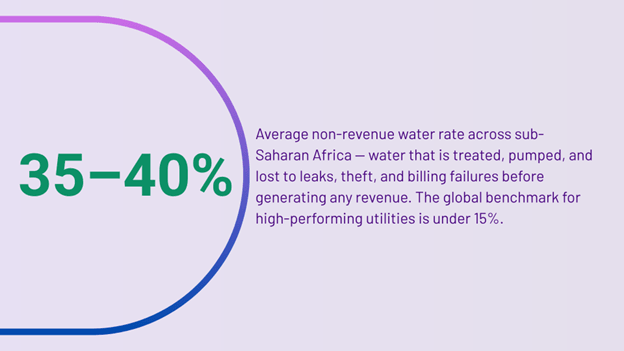
Where maintenance teams could be preventing failures, instead they’re responding to them as and when they occur. Critical pumping assets fail without notice. Emergency repairs cost three to five times what planned maintenance would have. Service disruptions follow. The reactivity of your operations isn’t by choice necessarily, but how can one be expected to react to a threat they never saw coming? This highlights the need for early-warning data.
Energy (typically accounting for 30–40% of a utility’s operating budget) is managed on fixed schedules with little real-time visibility into whether that spend is efficient.
These are not your conventional infrastructure problems in a sense. They are visibility problems. And visibility problems have a different class of solution: connecting the data that you already have inside your network to the people who need to act on it.
Three Forces Making This Moment Different
1. Investment Is Arriving At Scale, And It Follows Capability
Significant capital is being directed into East Africa’s water sector. The African Development Bank is managing an active water portfolio of over $6 billion across the continent, with major commitments in countries like Tanzania, Kenya, and Uganda.
This capital does not flow evenly. It follows the utilities that demonstrate operational efficiency, digital readiness, and the institutional capacity to absorb and deploy investment effectively. Utilities building that capability now are positioning themselves for a larger share of the next allocation cycle.
2. Regulation Is Moving From Guidance To Requirement
WASREB in Kenya publicly benchmarks utility performance. This makes your operational gaps visible to funders, governments, and the public. EWURA in Tanzania now requires licensed water utilities to operate ERP systems for digital performance reporting.
The regulatory direction is clear. If your operations as a water/wastewater COO, CTO or plant manager are building digital capability now, you’ll meet these requirements with little disruption. Delay can result in a compressed, costly compliance window.
3. The Technology Barrier Is Lower Than It Has Ever Been
Modern industrial software integrates with the SCADA infrastructure, metering systems, and asset records you already have, without your operations needing to implement large-scale replacements. It deploys in the cloud, on-premise, or in hybrid configurations depending on infrastructure, budget, and regulatory environment. The good news for most utilities is that the first step is connection rather than replacement.
What Leading Utilities Have Achieved
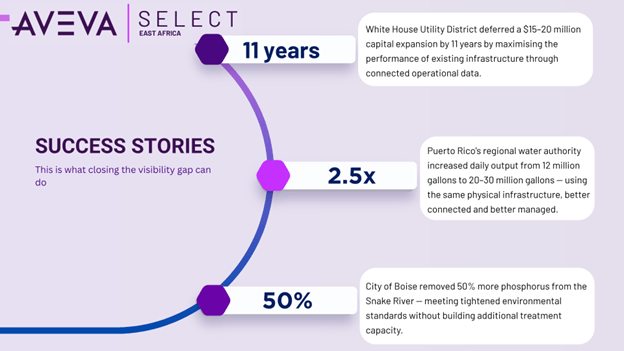
The outcomes here come from utilities that have closed the visibility gap. They represent what connected operational data consistently makes possible.
The ins of these utilities came by connecting the infrastructure they already had, and using the data it was already generating.
Where To Start: Identifying The Highest-Value First Step
Digital transformation in the water sector does not require a large, complex programme from day one. The utilities that have achieved the most have typically started with a specific, high-value first application and built from there.
If NRW is your primary challenge, the starting point is real-time pressure monitoring and district metering on the highest-loss zones. If you’re dealing with unplanned downtime, the most acute issue, it is asset condition monitoring on the two or three most critical pumping assets you want. For those facing regulatory reporting requirements, data integration is the answer. This makes compliance straightforward rather than manually intensive.
What all of these starting points share is a defined, measurable outcome, not a technology deployment. The outcome creates the business case, guides technology selection, and gives operations teams a clear measure of progress.
Complete our digital readiness checklist to see where your water utilities stand and what you can do to improve your operations.
ENDS